Julian Bream: ‘I’m a better musician now than when I was 70’

Two years ago Julian Bream was walking with his retriever, Django, in the fields around his Dorset home, when a neighbour’s dog knocked him to the ground, breaking both hips and injuring his left hand. For several years, Britain’s greatest virtuoso of guitar and lute had played through the pain of arthritis, but these new injuries compelled him to renounce making music seriously. He had retired in 2002 after 55 years of professional performing, but still liked to give the occasional recital at churches or halls near his home.


Thus ended his longest affair, one that started when nine-year-old Julian put on one of his dad’s Quintette du Hot Club de France LPs and was seduced by what he calls the “burning anguish” of Django Reinhardt’s playing.
Read more – interview in the Guardian with Stuart Jeffries

Segovia and Flamenco

Segovia on Flamenco Guitar, Song and Dance – from Guitar Review, 1977

Segovia’s stated credo was that he, like the Blues Brothers, was on a mission from God — well, maybe not God, but a sort of holy mission — to rescue the guitar from the taverns and the associated lowlife folks in whose hands it was then found. Obviously, he could have problems with flamenco.
Well, not quite, as it turns out.

Flamencos and Segovia

Manolo Cano, Andrés Segovia, Sabicas and Rafael Gómez Montero at the CONCURSO NACIONAL DE CANTE JONDO GRANADA 1922

Thanks to Brook Zern of the Flamenco Experience for this fascinating article.

Continue reading

Reflexive Speed – Jorge Caballero

At last, some hints from Jorge, whose ease of execution and acute analytical mind I have always admired. Quite difficult to understand this concept intellectually, but you will get it if you try it.
This has been around for a little while now and I am hoping for a new lesson soon!
Thank you Jorge.

In the meantime, there is an interesting excerpt here.

Continue reading

Over-Practicing Makes Perfect | TIME.com

We don’t just need to learn a task in order to perform it well; we need to overlearn it. Sounds like a recipe for disaster? Depends on your approach. I have to constantly remind myself that practice is supposed to make performing a task easier, not more difficult!
Do read the whole article before jumping to conclusions!

Whenever we learn to make a new movement, we form and then update an internal model—a “sensorimotor map”—which our nervous system uses to predict our muscles’ motions and the resistance they will encounter. As that internal model is refined over time, we’re able to cut down on unnecessary movements and eliminate wasted energy.

image

Over-Practicing Makes Perfect | TIME.com.

More Airline stories and some positive recommendations!

Seems that many people responded (positively) to the post on JAL’s treatment of guitars on internal flights, so as a way of jumping on the luggage carousel, I thought that I would add some positive recommendations.

For me, the most stressful part of taking a guitar on a flight is the uncertainty that it will be allowed as cabin baggage or not, or that it will be well taken care of in transit in the hold, so here is a list of positive experiences I have had with ground staff and flight crew.

Continue reading

Japan Airlines offers free guitar boxes to ease travelling musicians’ worries | RocketNews24

This is more like it. Makes me want to fly to Japan more! Contrast previous posts here and here

Recommendations and more stories here.

“For outgoing instrument service, we offer small and large instrument cases to support our customers on trips with important instruments. Now in response to customer feedback we have dispatched guitar sized cases (137cm x 44cm x 21cm) to all airports offering domestic flights. Until now, in such a case you would have to check it as fragile baggage, but from now you can ask for our guitar-exclusive case. JAL will continue to provide you with the best possible service in the future.” image

Japan Airlines offers free guitar boxes to ease travelling musicians’ worries | RocketNews24.

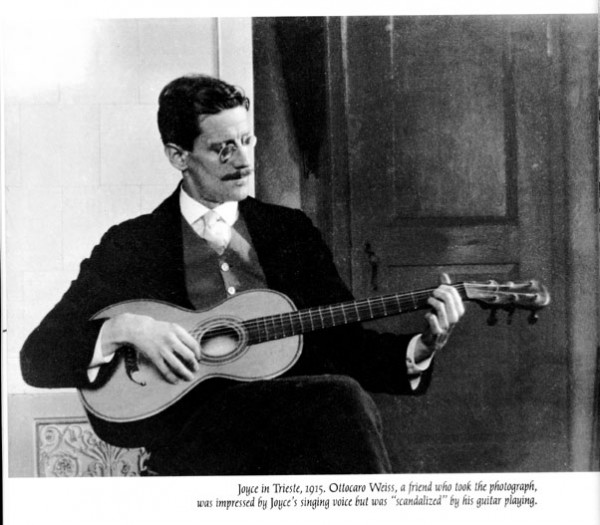
James Joyce’s guitar chord

Continuing my occasional foray into the guitar in literature, here is a famous picture of the author of “Ulysses” and “Finnegan’s Wake” presumably trying out a tune before a session (or maybe about to smash the guitar in frustration). In fact, Joyce was reputed to have had a fine tenor voice, and the singer John McCormack offered to teach him, encouraging him to take music as a career.

The original photo, taken by Ottocaro Weiss ,a friend who was “scandalized” by Joyce’s guitar playing, is housed in Cornell’s James Joyce collection, in an exhibit in a glass closet titled “Poetry and Music.”

Joyce

Continue reading

One in a billion – Xue Fei’s Sojourn

By paving the way and becoming an international star, Fei has become a role model in her native China. “Lots of young people [in China] see me having a good career, and I hope that I can make them realise that the guitar is a beautiful instrument.” Her passion for what she does is contagious. She speaks about the classical guitar and its music with the knowledge and experience of a veteran, yet with the enthusiasm and vigour of one who has just begun playing. “Personally, I always believed that the guitar the most well-rounded and self-entertaining instrument. It is so personal and intimate, as you have to hold a guitar with your body and to your heart.”

Continue reading